Showing posts with label temples. Show all posts

June 8, 2018

A trip to Jogja - Part 2: Spectacular Borobudur!


Hi Guys,

To read A trip to Jojga - Part 1: The 9th Century Prambanan Templeclick here.

Borobudur has a famous Sunrise tour which is supposed to give a spectacular view of the sunrise amidst the mountains, but with the rains I decided it was not worth making it. After waking up at 6 am, the walk to the temple was took 10 minutes. A group of foreigners were coming back down the temple stairs after completing the Sunrise tour. A large chunk of school kids had come in for touring the temple.

The famous Buddha statue amidst stupas and the picturesque mountain behind!

A view from the top of the temple
A view from the side of the temple
While Prambanan temple is largely a Hindu architecture, the Borobudur temple is slightly different. The temple’s structures is more like a large cube with layers of squares inside. Constructed in 9 layers with 118 meters width a 35 meters height, the outer six are squares and inner three are circular with bell shaped stupas around. There are 72 small stupas and one giant central piece. Apparently, this temple was also built in 9th century, probably before the Prambanan temple by the rival Sailendra Dynasty. And the temple was abandoned and rediscovered in the recent centuries. Indonesian Government has taken special interest in restoring the temple to show the world that they value their culture and are secular in nature.
The Rain Starts and the Umbrellas are out on rent!

One of the many Buddha Statues
As I reached the top of the temple and was having a look at the surrounding mountains and fields, the sky opened up and it started raining. And I having forgotten by Umbrella at the room had no choice but to take shelter at one of the pillars. And some Bollywood fanatic locals came up to take a picture – there a quite a few words that you will keep hearing across in Indonesia – it includes Shah Rukh Khan, Kuch Kuch Hota Hai, Ahchaa, Nahi… And as rain was not relenting, I took an Umbrella on rent (interesting business) for IDR 10,000 from the base. And then I began my walk up again to the top. After spending some time seeing the numerous Buddha statues around and taking a stroll through each of the layers which contains relics from the life of Gautama Buddha, I walked down. On the best of days with no rain, I believe one can sit in the top and enjoy the mesmerizing views around.

One of the many relics in the nine layers depicting the life of Gautama Buddha!
And one Selfie with the stupas amidst the rain!
Similar to the Prambanan temple, the complex is huge and there a lot of activities to do. Early in the morning, most of the souvenir shops were just being opened. And a chunk of tourists had started pouring in. Coming back to the guest house and munching on the no meat Nasi Goreng and feeding fishes in the paddy fields, it was time to head back to Jogja. This time, decided to take the local bus from Borobudur to Jogja. It costed IDR 25,000 a fraction of the Grab trip. The bus was as good as a rural Indian bus and the driver took his own sweet time to drive. Driving through some small towns and across rivers, we reached Jogja a little later than 1 pm.

The paddy fields behind the guest house. How peaceful life is here!
After having completed the main objective of the tour, it was time to have a look at the Jogja’s Royal Place called Keraton and a dutch time swimming pool in Taman Sari. And then I hit the traditional and classic shopping street of Jogja – Jalan Malioboro. After a stroll across, spent some time in souvenir purchase in the shop of Hamza Batik. After watching the local street vendors cook and the vintage street architecture, it was time to leave the lovely city.

One of the pools in the colorful Taman Sari - a swimming pool from the earlier centuries
The traditional Malioboro Street with a lot to shop!
The Batik drawing technique demonstrated live in Hamzah Batik store
And some Satays being prepared on the fly
As night falls, it is time to leave the wonderful city!
There is a lot more in Jogja than just the temples. There are few spectacular beaches to the west of the city, a few volcano treks around, an amazing cave visit is also there. All in all, to cover and enjoy Jogja in detail, you will need atleast 4-5 days with you which is a luxury.

Happy Reading!!!

May 27, 2018

A trip to Jojga - Part 1: The 9th Century Prambanan Temple


Hi Guys,

Indonesia is a large country with quite a lot of tourist places around the islands. Yogyarkata (pronounced Jogjakarta and often called as Jogja) occupies a key place in the hearts of the local Indonesians for the cultural heritage and amazing food the place offers. I decided to visit Jogja over a weekend back in March during my stay in Jakarta. The main aim of the trip was to cover the two major UNESCO sites – Prambanan and Borobudur Temples.

Hence, the first stop was Prambanan Temple. Situated at around 8 km from the Airport, I took a Transjogja bus to the temple. Prambanan temple (Candi Prambanan in local) is one of the giant Hindu temple complexes in the world. Constructed in the 9th century by Sanjaya Dynasty as an answer to the Buddhist Borobudur temple, the scale and magnitude of the temple is spectacular. Supposedly, there were a total of 240 temples in the complex. Can you believe it? Of course, not all of them were big. The biggest of all of them is dedicated to Lord Shiva and is 47 Meters tall. There are two other 33 Meters tall temples dedicated to Lord Brahma and Lord Vishnu. Naturally, the temple is called a Trimurti temple. Apart from the three major structure, there are quite a few tall temples dedicated to the vehicles of the Gods and smaller shrines dedicated to Goddess Saraswati and Laxmi. And there are 224 smaller temples surrounding the perimeter, most of which have been destroyed today.

A Side view of the Temple Complex
The three main temples from Behind -
On the Extreme left is the temple for Lord Vishnu, the one is the center if for Lord Shiva and the extreme right is of that of Lord Brahma
One of the flank temples
The temple complex is large and you have to be prepared to walk around a lot. The entrance fee is expensive. A combined pass to Prambanan and Borobudur temple costs USD 40 or IDR 540,000 (Indonesian currency can drive you crazy!) The temple was filled with a large number of local tourists, particularly school kids. Quite a few school kids flanked me as they were given an assignment to interview a foreigner.  After dictating the pre written questions and recording my answer, they wanted a photograph (Another thing you will come across is that kids will want to take photos with you, similar to how the Indian kids flank around  foreigners for a photograph).
The peripheral temples are damaged beyond restoration
A statue of Lord Ganesa in the Shiva temple

On an overcast day, it was humid and tiring to climb around all the temples to see the statues. The temple walls are filled with descriptions of Ramayana and Bhagavat Geetha. A large credit has to be given to the Dutch rulers and later the local Government for restoring the temple. The temple is in a very unstable zone with frequent Earthquakes and is also in a close proximity to many volcanoes around.
The temple is flanked with inscriptions of Ramayana - here is one of them with Lord Ram
Monument describing Earth Quake

And the fallen tower
By the time I was done with the main complex, I was tired and was not prepared to roam around the other three Buddhist Candis around in the same complex. On a good day, you can spend half a day around in this place roaming around temples, taking pictures from a few photographic points, renting a bicycle, visiting the museum and crawling through the local souvenir shops. There is also a spectacular Ramayana Ballet performance organized at regular intervals. Unfortunately, I was not able to attend them.
A Silhouette of the temples on an overcast day
After getting a few souvenirs, it was time to get to Borobudur. Booking a Grab from Prambanan made it an easy journey at a cost of IDR 145,000. Borobudur is 40 kms from Prambanan temple and after taking a stroll through the paddy fields and villages, we hit the highway. And Indonesia’s rainy season started the show. It was raining heavily and densely. Effectively, it took 2 hours to reach Borobudur where I had booked a home stay for the night. After having a no meat Nasi Goreng (Fried Rice) and some Chocolate Milkshake, I hit the bed.

The plan was to get up early in the morning and visit the temple before the tourist crowd hits in.

Click here to read Part 2 - Spectacular Borobudur!

Happy Reading!!!

January 1, 2018

A Visit to the Great Living Chola Temples!

Hi Guys,

Wish you a very Happy New Year 2018! I’m here back with another post on my recent mini trip across three famous ‘Great living Chola temples’ as referred by UNESCO. It was an adhoc trip and it turned out to be a great one.

Day 1 – Train to Kumbakonam and Sunset at Gangai Konda Cholapuram
I started by journey via Cholan Express to see the temples built by the Cholans. This train is one of those rare trains in Indian Railways which doesn’t run on optimal passenger load thanks to the presence of sleeper and AC coaches in a daytime train. So, it is a suitable train for Adhoc trips. Nevertheless, let me skip the train journey and focus more on the temples.  The train was an hour late as it reached Kumbakonam on the verge of 3 pm. It meant that I had to cut down Darasuram from Day 1 and keep it for day 2.

I kept my backpack in a nearby Hotel and got into a bus for Gangai Konda Cholapuram which is approximately 40 kms from Kumbakonam. The trip has a scenic dam on the way across Kollidam River. The dam has an island called ‘Anaikarai’ in between and the bridge on either side is one way which means vehicles have to stop on one side and wait for their turn. It was around 5.30 pm by the time I reached Gangai Konda Cholapuram.

Gangai Konda Cholapuram was built by Rajendra Cholan after he expanded his kingdom till the branches of the mighty river Ganga. He constructed the imposing temple here and moved the capital city to this place. A look at the place today and you will see it as nothing more a giant temple amidst a village. It is hard to believe a mighty kingdom was ruled out of this place once.

The Silhoutte of Gangai Konda Cholapuram amidst Sunset
The temple is completely built out of stone as are the other two temples. The temple’s main tower is the heart of the whole architecture. It is built very similar to the Thanjavur temple, but the key difference is that after the first two layers, the structure is more spherical in nature as against the tapering square in the Thanjavur temple. Incidentally, the temple is also named as Brihadisvara temple in line with the temple at Thanjavur. The temple has a giant Shiva Lingam and is a very peaceful temple with very little crowd around. The peace adds to the mystical feel of the temple. Outside the temple, the landscape is well maintained by ASI with lawns and trees attracting hundreds of pigeons and parrots. At Sunset, there was constant screeching from the parrots as they were settling down. Apart from the main temple, the surrounding complex has been destructed over time. After strolling across till sunset, I took a bus back to Kumbakonam and stayed there for the night.

The giant tower in Gangai Konda Cholapuram!

The big Nandi Statue and temple Flagstaff
Day 2 – Darasuram and Thanjavur
After thinking of starting as early as 6 am in the morning, I slept off and got ready by 7 am. Darasuram is a Suburb of Kumbakonam and is only 2-3 kms away from the main town. It was around 7.45 am when I reached the deserted temple. The temple is constructed a bit lower than the surface which means that you have to climb down a few steps and get into stagnant water (from the rains) to get inside the temple. Since, the temple is below surface level, water keeps creeping in through the stone floor, which has resulted in Algae bloom and not so pleasant odour.

This temple known as ‘Airavateswara Temple’ was built by Raja Raja Chola II in the 12th century. The temple is said to be a much bigger complex with seven streets. However, only the main complex is present today. The temple is dedicated to Lord Shiva. As I went in so early, the priest was yet to come and he came leisurely after 8 am, by when a few tourists had come. So, a late start did help the process.

The temple is not as magnificent as the other two in terms of size, but it makes up with the intricate carvings on stones across the temple. For this reason, the temple reminded me of the Vittala temple in Hampi.
Darasuram temple entrance, which is a few feet below the ground level

The Chariot Shaped temple that reminded me of Vittala temple in Hampi

Those Intricate Stone Carvings!
I then came back to Kumbakonam, had my breakfast and started to the biggest and famous of the three temples in Thanjavur. After a bumpy ride, I reached Thanjavur around noon. Unlike the earlier two temples, this one was bristling with crowd and in particular lot of tourists had arrived at the complex.

This temple was constructed by the famous king Raja Raja Chola I in earlier 11th century and recently the temple celebrated its 1000th Anniversary. Named Birhadesvara which means the ‘Big Shiva’, the Shiva Lingam in the temple is huge fittingly. The temple is more famous for the giant Nandhi statue at the entrance and the colossal tower in the centre of the temple. The main tower is 16 storeyed with 13 of them tapering towards the top. The centre piece is the giant monolithic stone which completes the tower. It is an architectural wonder considering the grandeur and age of the temple.

Unlike the other two temples, this temple was significantly improved by the later Nayak rulers adding more sanctums and idols to the temple. Chief among them is the gigantic monolithic Nandhi statue at the temple’s entrance. It’s amusing that Raja Raja Chola’s son left this magnificent city and temple to construct a new capital at Gangai Konda Cholapuram. Had it not been for the later Nayaks and Marathas, Thanjavur too might have faced the same fate of the other two temple towns.
Unlike the other two temples, the main temple in Thanjavur had two giant entrance doors!

The magnificent temple complex!

Elephants and Horses carved on stones seems to be a common thing across the temples!

Not just the main tower, the other towers in the temple too are large and filled with intricacies which makes the complex an amazing one!
History is interesting! Cities that flourished once upon a time have fallen down big time today. While some like Thanjavur are still surviving albeit not to the full flurry, cities like Hampi or Gangai Konda Cholapuram have vanished. Forests and deserts have become big urban clusters today. Who knows what would happen to these cities tomorrow?

On that thought, I left Thanjavur and went to Srirangam before boarding a train back to Chennai!


Happy Reading!

June 25, 2012

Thirparappu Waterfalls!

Hi Guys,


At the starting of this month, I went to Nagercoil for a friend's marriage (actually this blog's inspirer and motivator Vijay Dinesh was getting married - wish him a very Happy married life). So I went to Kanyakumari and nearby places with my parents the previous day. Initially I thought of blogging, but later left the idea as I was quite busy after that. My mother was asking why I didn't write about that trip and so I decided to write about a part of the trip that was Thirparapu Waterfalls.

Whole view of the falls
We started from Nagercoil from around 8 am and though the distance was less, the path was not as good. The journey through the bumpy road took around 2 hours. The monsoon season had just started there and it started to rain on the way. Thank God, it stopped raining when we got there. The journey was quite interesting as it was scenic around. There were lot of rubber estates, jack ftuit trees and many other mountainous trees. The lifestyle of the people was different. It was much like a blended style between Tamil Nadu and Kerela. After two hours we got there and the entrance ticket was around Rs. 5 (I guess – don’t remember exactly).

Water falling
The water fall is about 300 ft in length and has Rocky River beds. It falls from a height of 50 ft and looks to be artificially constructed one. The falls is located downstream and you have to climb down some steps to get to the falls. The facilities were quite good. A good looking park was set up and apart from that there were Children’s play area and a swimming pool dedicated for Children.

Children's Swimming pool and play area
There were quite a good number of people that day. Some were interested in bathing, some were interested in just enjoying the scenery and some like me were involved in taking photographs. So, I explored the area.

Decoration in the park!
The river bed or the place where people stand and bath was quite slippery in nature, but it was not very risky (there were some interesting falls, but no one was injured). The water after flowing from the falls flows continues its journey and the place was quite risky. On the outside it appears as if there are steps leading you down (as it is cut at 90 degrees), but it is just a plain cut and leads you to a 10 feet trap that is so rocky.

Downstream
Adjacent to the waterfalls, or actually adjacent to the river upstream there is a temple known as Mahadevar Temple, which is said to be one of the twelve shivalayas in the area. The temple is built completely in Kerela style, which was quite amazing to me. A circular shape structure with a conical doom. Lord Shiva was looking so good in the temple, very intricately designed. I would say it was one of the best idols I have seen. No one was there at the temple, except two or three devotees, so it was very peaceful and I like peaceful temples.

The Mahadevar Temple from the outside
Outside the temple, the scene was beautiful. The stream was flowing smoothly and some people took bath there. The temperature was so good as it was cloudy and it was not raining.

Outside the temple
Outside the temple - the other side
On the way back, we had to catch a bus to Kulasekaram, a nearby town. The bus was interesting. A large space was allotted to keep luggage (as seen below) and the number of seats for people were less. I think it is designed so as to transport goods from the estates around. I sat in the luggage rack for the 15-20 minute journey and it was not comfortable, but enjoyable. From there we took a bus to Nagercoil and this time the journey was more tedious as more roundabout route was followed. All together the trip was unforgettable!

The luggage raft in the Bus - on the way back
Scenic Beauty on the way back!
The Waterfalls is located in Kanyakumari district very near to the borders of Kerela. It is approximately 45 kms from Nagercoil, 55 kms from Thiruvananthapuram and 65 kms from Kanyakumari. The water fall is located in a river named Kothaiyar and is located at about 13 kms from Pechiparai Dam. The waterfall is active for seven months in a year (I'm not exactly sure - but guess it would be June - January). Boat facility is available at the other side of the temple.

Route from Nagercoil and Thiruvanthapuram - B is the location of Thirparappu Falls
There are lots of tourist spots around. Interested people can check for information in the web. The tourism website of Kanyakumari gives all the information. If you go there in your own vehicle or if you book a cab, you can enjoy nature to the core!

Happy Reading!

May 26, 2012

Trekking at Azhagar Kovil - 3

Hi Guys,


It took a long time for this concluding post due to my exams.

12.40 pm: We started moving down. This is where I left the previous post.

12.51 pm: The water we collected at the Raakaie Amman Temple was nearly empty as Saravana didn't collect properly. Bala said that there is another temple nearby on the way down where the we can collect the water from another opening of the stream. We reached there by 12.50 pm. It was a small temple that was a 2 minute walk from the main road. It was visible from the road, if observed carefully.
The Path to the temple
12.55 pm: It was five minutes before Saravana collected water from the water stream that was flowing through a pipe. It was some 10 feet below the ground. The water was again very clean and had some herbal flavour. There were a very few people who were preparing to take bath. The water was very cool and the sun was quite hot.
Water flowing through a pipe.
The small temple
1.08 pm: Another 15 minutes of walking and we reached the Ice Cream vendor - the man who sold Ice Cream at the dividing point between the road and natural path. It meant we had completed nearly half the journey in the downward path.
The Ice Cream Vendor
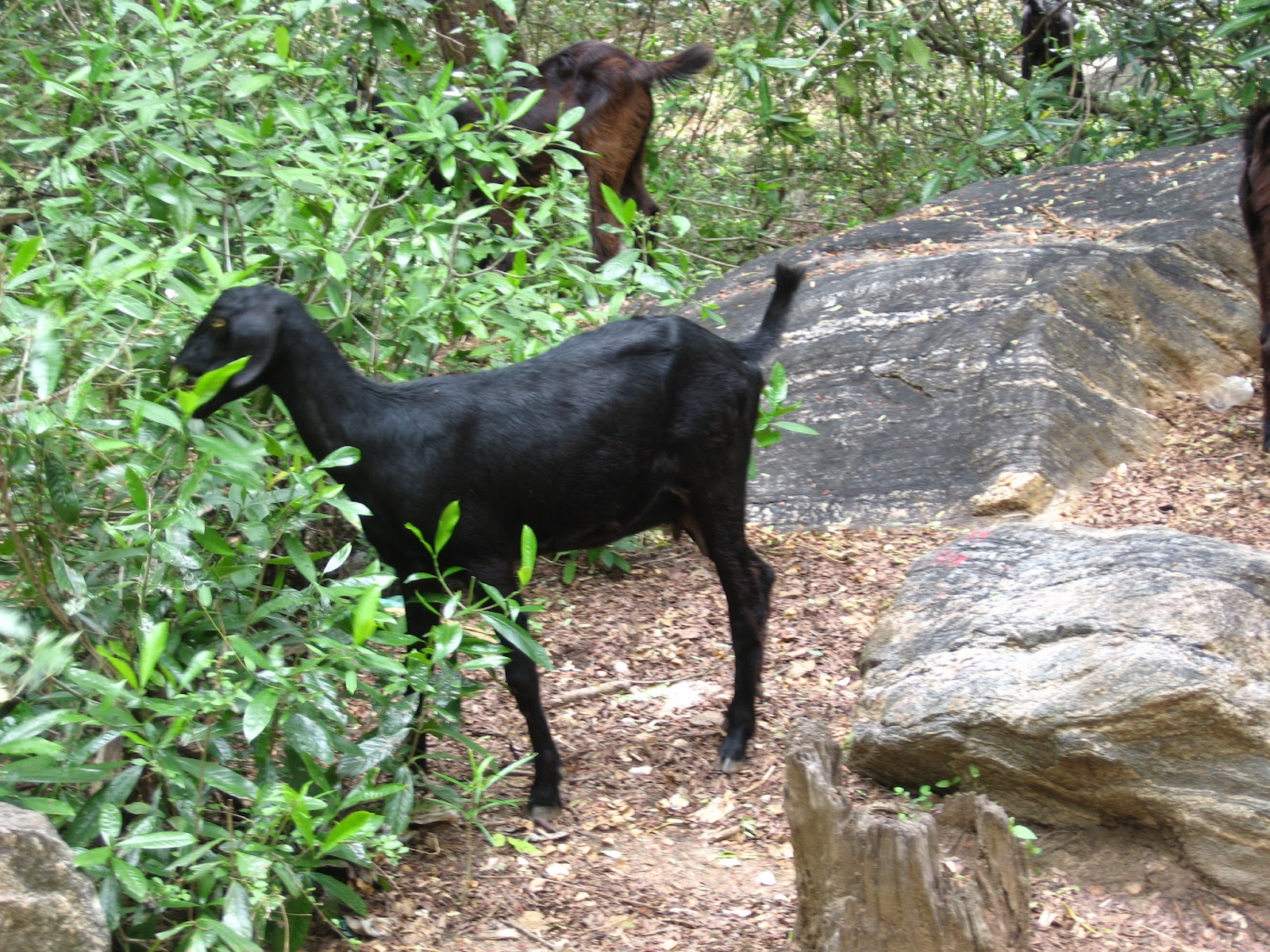
1.29 pm: We sat in a rock for some time. Bala had captured a butterfly and after some efforts he took shots in different positions before leaving the butterfly back to freedom (we didn't hurt the butterfly). After that we continued our journey towards the base. We spotted some goats drinking water in the stream and eating plants.
Goats
1.40 pm: We reached the base of the temple after some 10 minutes. We were so tired by then and it was relieving to see the wall of the temple.
Nearing the end of the journey.
1.45 pm: It took us five more minutes to reach the starting point. After capturing some shots we moved to the bus stop.
The entrance of the temple
A mandapam outside meant for devotees to rest.
It took us nearly 1 hour to come down. Leaving the rest period, I could say it took us 45 minutes. Walking down was easier than moving up. After drinking water, we moved to bus stop by 2 pm and it was lunch time. There were no buses there.

It took another 15 minutes for a bus to come and there was a big crowd. Again I was left with no buses at the other bus stand and hence I reached home finally by 4.15 pm. I was so tired by then.

Walking for a long distance after a long time didn't do anything that day. But when I woke up the next day, my whole body was aching and moving within the home itself was a trouble. Anyway it was a good exercise for the muscles and I got back well soon.

It was an unforgettable experience was me along with Bala and Saravana. Hope to do another activity soon.

I will write about the history of the temple and suggestions for trekking here in my next post (or soon).

Happy Reading and Viewing!!!